ml-peak-shape-generator
ml-peak-shape-generator




Generate various peak shapes.
The current supported kinds of shapes:
| Name | kind |
Equation |
|---|---|---|
| Gaussian | gaussian |
|
| Lorentzian | lorentzian |
|
| Lorentzian Dispersive | lorentzianDispersive |
|
| Generalized Lorentzian | generalizedLorentzian |
|
| Pseudo Voigt | pseudoVoigt |
|
| Pseudo Voigt (TCH) | pseudoVoigtTCH |
The pseudo Voigt above, with independent gaussian and lorentzian widths fwhmG and fwhmL. The effective fwhm and mu are derived from them through the Thompson–Cox–Hastings approximation. |
| Split Gaussian (asymmetric) | splitGaussian |
Two gaussian halves sharing the apex: the lower-x half (t ≤ x) uses fwhmLow, the higher-x half (t > x) uses fwhmHigh. |
The only 2D shape is gaussian, whose widths are set per axis.
where
Installation
$ npm i ml-peak-shape-generator
This package allows to calculate various shapes. By default they will have a height of 1.
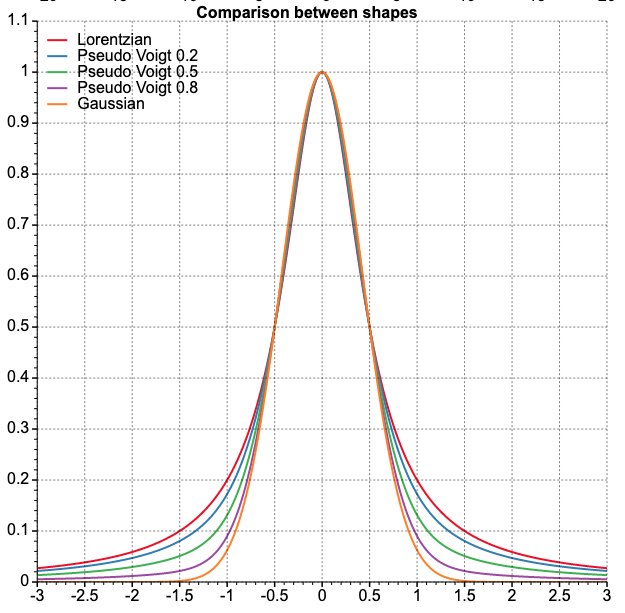
You see the resulting functions using this playground
Usage
import {
getGaussianData,
getLorentzianData,
getPseudoVoigtData,
} from 'ml-peak-shape-generator';
// It's possible to specify the windows size with factor option
let data = getGaussianData({ sd: 500 }, { factor: 3.5 });
// or fix the number of points as Full Width at Half Maximum
let data = getGaussianData({ fwhm: 500 }, { factor: 3.5 });
// It's possible to specify the windows size with factor option
let data = getLorentzianData({ fwhm: 500 }, { factor: 5 });
// It's possible to specify the windows size with factor option
let data = getPseudoVoigtData({ fwhm: 500 }, { factor: 5 });
It is also possible to take an instance of each kind of shape:
import { Gaussian, gaussianFct, Gaussian2D } from 'ml-peak-shape-generator';
const gaussianShape = new Gaussian({ fwhm: 500 });
// It is possible to set a new value for fwhm
gaussianShape.fwhm = 300;
// By default the height value ensure a volume equal 1.
const symmetric2DShape = new Gaussian2D({ fwhm: 500 });
// It is possible to set values for sd, fwhm and factor for each axes.
const gaussian2DShape = new Gaussian2D({ fwhm: { x: 300, y: 500 } });
// It is possible to set new value for fwhm by:
gaussian2DShape.fwhm = { x: 300, y: 500 };
// or set the same value for both axes.
gaussian2DShape.fwhm = 400;
// An instance of any shape has the same methods accessible for each
// shape e.g. fct or getData, but these use the internal parameters. e.g:
gaussianShape.fct(5);
gaussianFct(5, 500);
// getData
gaussianShape.getData({ factor: 3.5 });
import { getShape1D, getShape2D } from 'ml-peak-shape-generator';
// If you want to dynamically select a shape you can use `getShape1D` /
// `getShape2D`. They return an instance of the required kind of shape.
const lorentzian = getShape1D({ kind: 'lorentzian', fwhm: 500 });
const gaussian2D = getShape2D({ kind: 'gaussian', sd: 500 });
Descriptors, instances and serialization
A shape exists in two forms: a descriptor — a plain object such as
{ kind: 'gaussian', fwhm: 500 } — and an instance, the class that computes
the curve. getShape1D / getShape2D turn a descriptor into an instance.
An instance carries its own kind and serializes back to a descriptor, so a
shape survives a trip through JSON:
import { getShape1D } from 'ml-peak-shape-generator';
const shape = getShape1D({ kind: 'pseudoVoigt', fwhm: 500, mu: 0.3 });
shape.kind; // 'pseudoVoigt'
JSON.stringify(shape); // '{"kind":"pseudoVoigt","fwhm":500,"mu":0.3}'
const restored = getShape1D(JSON.parse(JSON.stringify(shape)));
restored.fct(5) === shape.fct(5); // true
toJSON emits the parameters the shape is defined by — those getParameters()
reports — so a round trip preserves both the curve and its analytical
derivatives. A splitGaussian therefore emits fwhmLow and fwhmHigh rather
than its mean fwhm, and a pseudoVoigtTCH emits its component widths fwhmG
and fwhmL. Options that are alternative ways to express a width, such as sd,
are resolved first and emitted as the resulting fwhm.
Because an instance is itself a valid descriptor, handing one back to the factory copies it:
const copy = getShape1D(shape); // a new instance with the same parameters
The kind strings are exported as types:
import type { Shape1DKind, Shape2DKind } from 'ml-peak-shape-generator';
// Shape1DKind: 'gaussian' | 'lorentzian' | 'lorentzianDispersive' |
// 'pseudoVoigt' | 'pseudoVoigtTCH' | 'generalizedLorentzian' |
// 'splitGaussian'
// Shape2DKind: 'gaussian'
It is also possible to get a function that allows to calculate y for any x
import { gaussianFct } from 'ml-peak-shape-generator';
const func = gaussianFct(x - mean, fwhm);